Originally published on Substack
I listened to a podcast the other day that disturbed me deeply.
In it, the primatologist Frans de Waal described something that many primatologists find profoundly uncomfortable: seeing baby chimpanzees smiling in television advertisements. The reason is simple. They are not smiling at all. What human audiences interpret as a happy grin is often a fear grimace. The expression looks enough like a smile to fool us, but it means something entirely different to the chimpanzee. As de Waal explained, one of the easiest ways to produce that expression is to frighten the animal. The audience sees happiness. The scientist sees fear.
That thought stayed with me long after the podcast ended. Not because of the chimpanzees. Thankfully, we have largely moved beyond using chimpanzees in this way. At some point we became uncomfortable with it. We recognised that they are too much like us. Too cognitively sophisticated. Too emotionally complex. Too obviously sentient. Looking at a frightened chimpanzee performing happiness for an audience no longer feels entertaining. It feels wrong.
But listening to de Waal, I realised there is another animal whose emotional expressions we routinely misunderstand and exploit.
The horse.
Dressage treats passage as a movement. It is not. Passage is not locomotion in the ordinary sense. It is not simply a way of travelling from one place to another, nor is it merely a particular arrangement of limbs moving through space.
Passage is an emotional expression.
Horses do not tell us how they feel with words. They don't smile. They don't laugh. They don't cry. Their emotions are expressed through their bodies. Emotion in horses is embodied. The depressed horse has a particular posture. So does the horse in pain.
Anyone who has spent enough time watching horses at liberty knows exactly what happens when a horse feels magnificent. Another horse appears. The herd begins to move. Excitement spreads through the group. The neck rises, the back lifts, the forehand elevates, and the horse seems to grow before your eyes. The movement becomes suspended, expressive and powerful. The horse is no longer merely moving. It is displaying itself.
The trot begins to float.
Not because the horse has been trained to perform passage.
But because passage is what joy looks like in a horse.
It is what confidence looks like. It is what exuberance looks like. It is what a horse does when it feels so good that it wants every other horse around it to notice.
That, I think, is why passage has fascinated horsemen for centuries. It is not beautiful simply because of the mechanics. It is beautiful because of the state that produces it.
It is breathtaking to watch.
And it is also why it has never truly been possible to reproduce.
We can reproduce the mechanics. We can influence the stride, manipulate the frame, alter the timing, and place every visible piece in approximately the right position. But resemblance is not the same thing as reality. A smile that does not reach the eyes is not a smile. A chimpanzee fear grimace is not happiness. And movement that imitates the shape of passage is not passage.
Because passage is not fundamentally a movement.
Passage is a state.
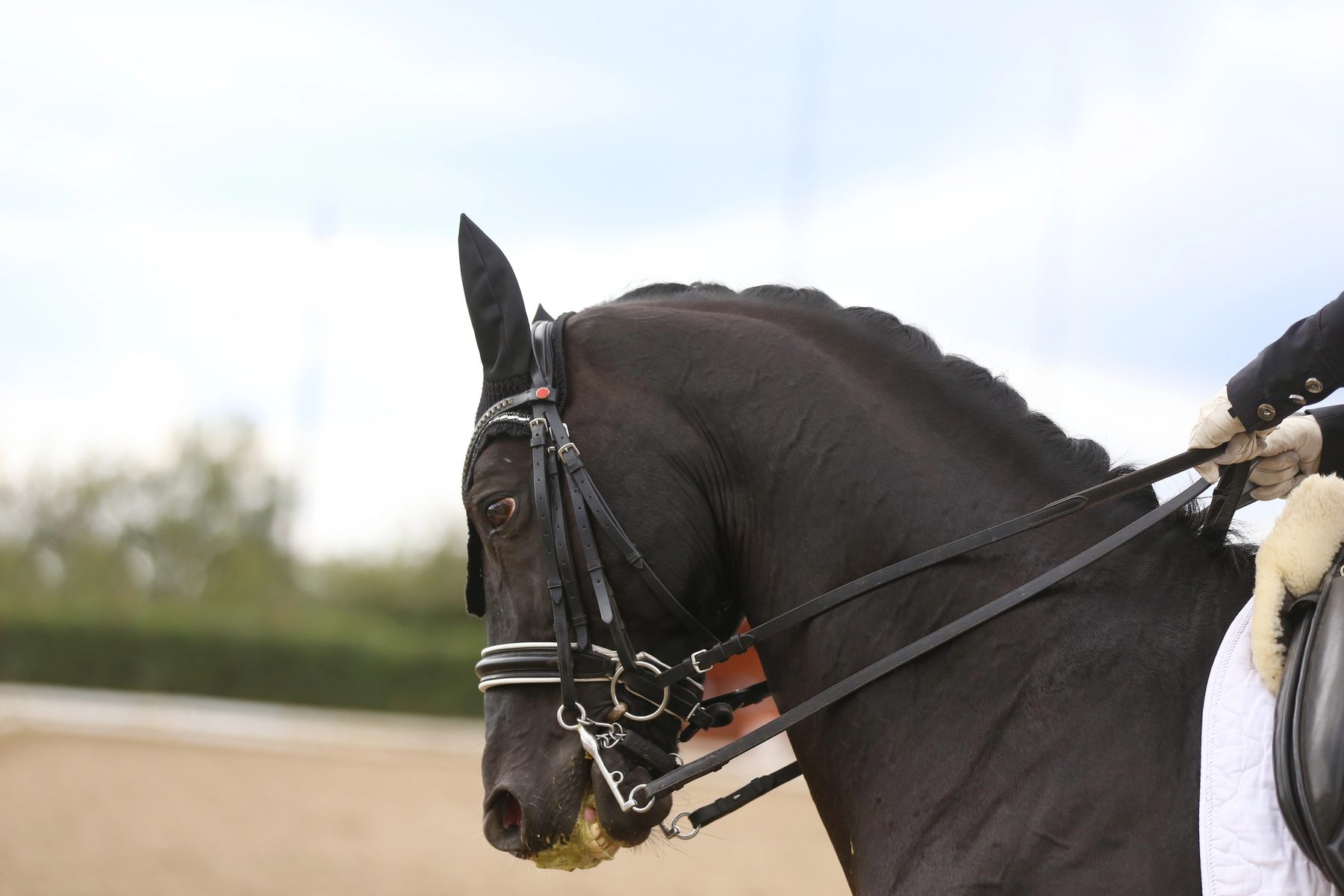
The tragedy, in my view, is that modern dressage has become extraordinarily good at reproducing the appearance while losing sight of the experience. The legs move in the correct sequence. The forehand elevates. The horse appears expressive. The judges award marks. The audience applauds. Yet the question that matters most is rarely asked.
What is the horse feeling?
If the answer is not exhilaration and exuberance and joy, then what we are doing is wrong. We are reproducing the visible signs of an emotion without requiring the emotion itself — with negative reinforcement at best, and fear at worst.
And that is why the comparison with the chimpanzee matters.
The baby chimpanzee in the advertisement appears happy. The audience sees a smile and assumes the feeling that should accompany it. The expression becomes detached from the experience that originally gave it meaning.
I increasingly wonder whether dressage has done something similar.
The horse at liberty passages because it feels magnificent. The horse in the arena passages because it has to. If it had a choice, it would stop and leave.
The movements may look similar. The states that produced them may be entirely different.
This is why I no longer believe that dressage can ever be fully reconciled with welfare. Not because riders are cruel. Not because judges are malicious. Not because horses are incapable of learning. But because the sport is built around reproducing the outward appearance of a state that can only ever be genuine when it arises from within the horse itself.
And baby chimpanzees do not smile.