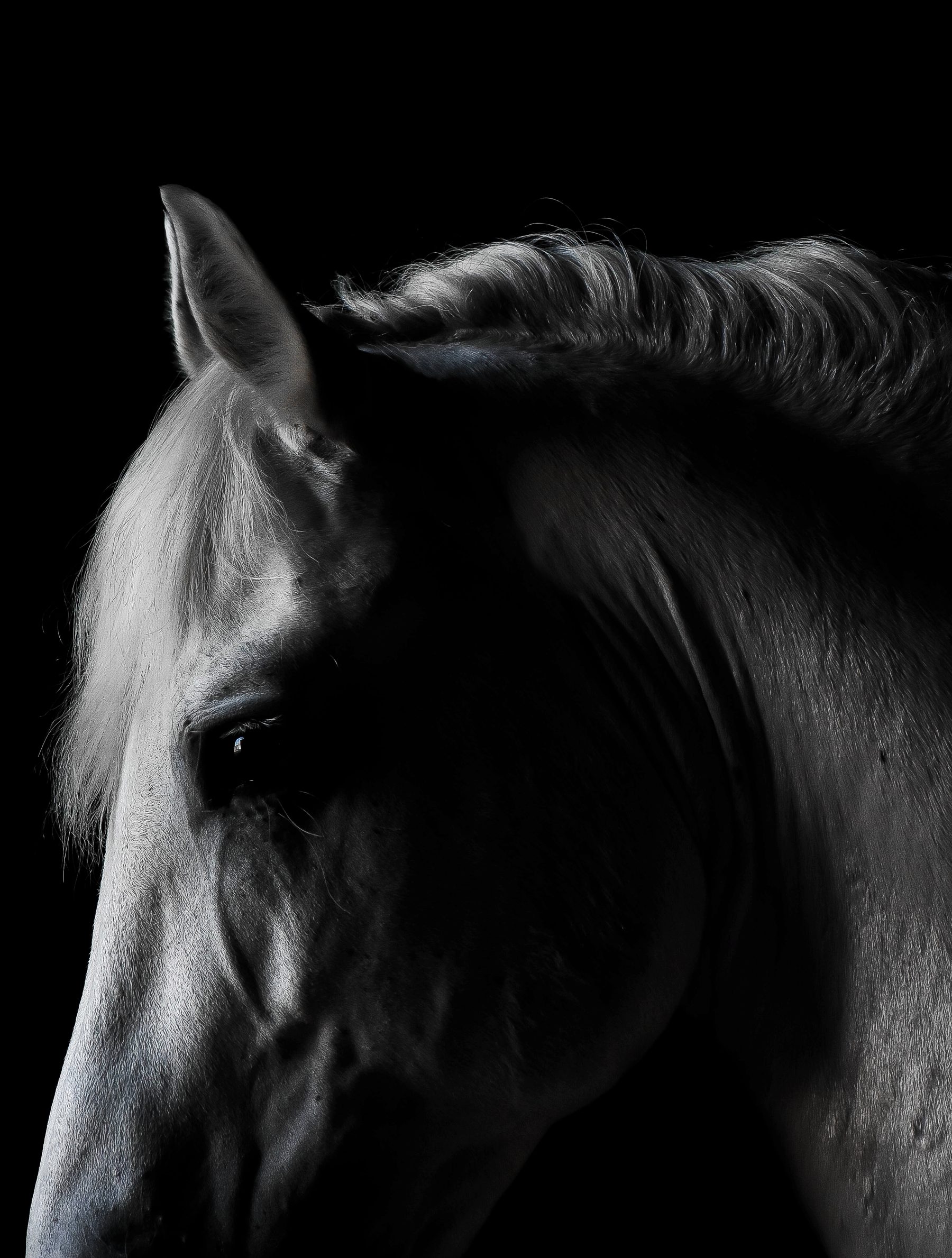
Originally published on Substack
Having spent half a century entrenched in the equestrian world — most of it competitive, surrounded by horse lovers and animal lovers — I have become very accustomed to avoiding the subject of emotion.
So we learn to arrange our thinking around animals as though they are largely unemotional. We talk about behaviour, training, responses. We describe what they do, but we avoid asking what they feel.
But the truth is much simpler.
There are seven primary emotional systems common to all mammals:
SEEKING, CARE, LUST, PLAY, RAGE, FEAR, PANIC/GRIEF.
Our horses feel all of these. As do we. And in training horses — if we are honest — we see all of them.
SEEKING in a horse is curiosity, forward intent, exploratory movement. It is the horse that goes to the gate to see what is happening, that stretches into the environment, that moves with purpose without being driven. In ridden work, this is very close to what classical texts were trying to describe — but could not quite name — as willingness, or "going forward of its own accord." When SEEKING is active, locomotion tends to look fluid, connected, and self-propelled.
CARE is social bonding — attachment to humans or other horses. This matters far more than we tend to acknowledge. A horse that feels safe with a handler or rider processes everything differently. Predictability, consistency, and trust all sit here.
PLAY shows up as looseness, variability, elasticity, social engagement — the spontaneous expression you see in paddock movement. It is not trivial. It is critical for motor learning. A horse in PLAY is not simply "happy" — it is neurologically in a state that supports coordination, adaptability, and learning.
FEAR reorganises everything around threat. Attention narrows, posture changes, movement becomes about vigilance or escape.
RAGE appears when the horse is blocked, restrained, or prevented from achieving a goal. This is where we see resistance, tail swishing, bracing, kicking — what we often call "conflict behaviour."
PANIC is separation distress — the horse that becomes distressed when removed from a herd mate or a place of safety.
SADNESS, or depression, presents as withdrawal: a flat affect, a quiet, shut-down demeanour, often accompanied by a long, level posture of the head and withers.
Every interaction a horse has throughout its day is processed emotionally.
Our horses are not occasionally emotional — they are continuously emotional. Every interaction is experienced, interpreted, and laid down as memory through these systems.
Work, then, is never neutral.
It can be experienced as play — bringing feelings of curiosity, anticipation, satisfaction.
Or it can be experienced through fear, frustration, uncertainty, discomfort, or pain.
Together, this moment-to-moment emotional condition is described as affective state.
At any given time, a horse exists within an affective state that can be understood along two dimensions: valence — how positive or negative the experience is — and activation (arousal) — how much energy is in the system.
These systems do not just produce behaviour like "spooking" or "kicking."
They reorganise the entire body.
A horse in FEAR or PANIC does not just feel different — it moves differently. Muscle tone changes. Recruitment patterns shift. Rhythm and stride organisation alter. Head and neck posture adjust. Willingness to go forward is affected.
Movement is not separate from emotion. It is organised by it.
In dressage, this leads to an uncomfortable reality.
Horses can work — and perform — across two very different states: a SEEKING/PLAY-dominant state, producing exploratory, elastic, self-organised movement (what we recognise as true engagement, or losgelassenheit), or a FEAR/ANGER/PANIC-dominant state, producing controlled, constrained, protective movement (what we might call defensive movement).
Both states can produce movement that looks powerful. Even spectacular.
Because the body can be organised in two fundamentally different ways: through internal motivation and coordinated, fluid movement, or through tension, restraint, and protective patterning.
From the outside, the picture can look similar. But the internal organisation is not. And if movement can arise from two completely different internal states, then what we are seeing may not be what we think we are seeing.